

If you’ve searched for “ikigai” in the last few years, you’ve almost certainly seen the same picture: four overlapping circles — what you love, what you’re good at, what the world needs, what you can be paid for — with “Ikigai” glowing in the middle where they meet. It’s tidy, it’s shareable, and it shows up on posters in co-working spaces everywhere.
It’s also not where the concept came from, not what the bestselling book about it is actually about, and — used carelessly — not as useful as it could be. Used properly, though, ikigai turns out to be one of the more evidence-backed tools available for a very specific, very current problem: working out what’s actually yours to offer at a moment when artificial intelligence is quietly automating the parts of a job that used to define it.
This article goes past the poster version. It covers where ikigai actually comes from, what peer-reviewed research says about it, and — through two real scenarios drawn from Skillset Centre’s own career workbooks — how to run your own ikigai job search properly in the AI era.
What Ikigai Actually Means: Two Very Different Traditions
The psychiatrist who coined the modern concept
The word ikigai (生き甲斐) long predates any diagram. Its serious academic treatment begins with Mieko Kamiya, a Japanese psychiatrist who spent years working with patients at the Nagashima Aiseien leprosy sanatorium and published the foundational text on the subject, Ikigai-ni-tsuite (“On the Meaning of Life”), in 1966. Kamiya’s ikigai has nothing to do with career-matching. It’s an existential concept — the felt answer to questions like “what is my existence for?” and “who is it for?” — built from her clinical observation that people could sustain extraordinarily difficult circumstances when they held a clear, personal sense of purpose, and could be devastated even in comfortable circumstances without one.
One of Kamiya’s specific observations matters a great deal for anyone reading this mid-job-search: she noted that ikigai and seikei (one’s means of livelihood) frequently pull against each other, and that the tension between the two — between what genuinely feels like your reason for being and what actually pays the bills — is a real and common source of distress, not a personal failing or a sign you’re doing life wrong. Keep that in mind; it resurfaces in both case studies below.
The bestselling book — and what it’s actually about
Most people’s second point of contact with ikigai is Héctor García and Francesc Miralles’ 2016 bestseller, Ikigai: The Japanese Secret to a Long and Happy Life. It’s worth knowing what’s actually inside it, because it’s not a career guide. The book is a field study of Ogimi, a village in Okinawa — one of the world’s “Blue Zones” studied for exceptional longevity — built on interviews with centenarian residents. It draws on Viktor Frankl’s logotherapy and Mihaly Csikszentmihalyi’s concept of flow, and distils its practical advice into ten broad rules for living: stay active, don’t rush, eat moderately, keep good friends, get fit for your age, smile, reconnect with nature, be grateful, live in the present, and follow your ikigai. It is a book about longevity and daily living, not a job-matching framework — and, notably, it does not contain the four-circle diagram at all.
Where the four circles actually came from
So where did the diagram come from? In 2014, a blogger named Marc Winn published a post adapting a “Purpose” Venn diagram originally created in 2011 by the Spanish consultant Andrés Zuzunaga, mapping the intersection of passion, mission, vocation, and profession. Winn relabelled the centre “Ikigai,” borrowing the framing from Dan Buettner’s earlier TED Talk on Okinawan longevity, and the combined image went viral. That’s the honest lineage: a Western business-consulting Venn diagram, given a Japanese name, two years after the concept it borrowed the name from was popularised in English by a completely different book.
None of this makes the four-circle version useless — it’s a genuinely useful simplification, which is exactly why Skillset Centre’s own free Ikigai Test is built around it. But a 2025 academic paper on using ikigai in career counselling puts the caution plainly: scholars warn that the popular diagram “risks stripping ikigai of cultural nuance, turning it into a static ‘life purpose diagram’” when it’s used on its own, without the deeper tradition behind it (Jedvaj & Skrbinjek, 2025). This article — and the two case studies below — are an attempt to use the practical tool properly, with that nuance restored rather than stripped out.
What the Research Actually Shows
Ikigai has moved well beyond blog posts and TED Talks into peer-reviewed psychology, and the findings are genuinely relevant to a job search, not just a nice philosophical footnote.
In 2019, researchers Dean Fido and Yasuhiro Kotera at the University of Derby, working with Kenichi Asano at Mejiro University in Tokyo, published an English validation of the “Ikigai-9” — a nine-item scale originally developed in Japan — using a sample of 349 UK adults. Their statistical analysis found that ikigai functions as a single, coherent psychological construct in Western populations (rather than the three separate factors the original Japanese version proposed), and that higher ikigai scores predicted meaningfully greater wellbeing and lower depression scores, independent of age or sex (Fido, Kotera, & Asano, 2019). In plain terms: a stronger, clearer sense of “why,” measured with a validated instrument, tracks with better mental health outcomes — which matters enormously to anyone navigating the uncertainty of a job search or a mid-career pivot.
More recent work has pushed this into the workplace specifically, building integrated cognitive-motivational models of how a sense of purpose operates in day-to-day working life, and — most relevantly for this article — into formal career guidance. The 2025 paper by Karmen Jedvaj and Vesna Skrbinjek, published in the journal Societies, proposes explicitly integrating ikigai into career counselling practice, drawing on Self-Determination Theory, logotherapy, and expert interviews with practitioners who’ve already embedded it in university curricula. Their key finding is that ikigai works best as “a process of daily living” rather than a single breakthrough insight — people often return to it repeatedly across a career, particularly during transitions — and that it complements rather than replaces established, well-validated career frameworks like Holland’s RIASEC model and Social Cognitive Career Theory, adding a meaning-making dimension those models don’t cover on their own (Jedvaj & Skrbinjek, 2025).
Put together, the honest academic position on ikigai is this: it’s not ancient Japanese wisdom about careers, and the diagram most people know is a recent Western invention — but the underlying construct is real, measurable, linked to genuine wellbeing outcomes, and increasingly taken seriously by career-development researchers as a useful complement to more established tools.

Why This Matters More, Not Less, in an AI Job Market
Here’s the part that connects all of the above to the moment you’re actually job-searching in. Generative AI is very good at automating tasks — drafting, summarising, formatting, basic analysis — and it is making rapid, visible inroads into exactly the kind of routine, definable work that most job titles used to be built around. It is not, and cannot be, a substitute for purpose: the reason a particular kind of work matters to a particular person, and the judgment that comes from actually caring about the outcome.
Two established strands of psychology explain why that distinction is now a practical career asset rather than just a nice idea. Self-Determination Theory (Deci & Ryan) holds that motivation and wellbeing depend on three needs — autonomy, competence, and relatedness — that map closely onto the “love” and “good at” circles of the ikigai model, and that are precisely the needs a role stops meeting when its meaningful content gets automated out from under a job title. Separately, job crafting research (Wrzesniewski & Dutton, 2001) shows that people who actively reshape the tasks, relationships, and framing of their role around what they actually value and do well — rather than passively accepting a fixed job description — report higher engagement and are more resilient through organisational change.
An ikigai self-audit is, in effect, the diagnostic step that makes job crafting possible: you can’t reshape a role around your strengths and purpose until you’ve separated those from the specific tasks and tools currently sitting on top of them.
That reframe — separating the enduring pattern from the disposable task — is exactly what both case studies below turn on.
Two People, Two Ikigai Gaps

(Illustrative examples featuring characters from Skillset Centre’s own career workbooks — not real individuals.)
Priya: three strong circles and one empty one
Priya is one of the three central characters in Skillset Centre’s workbook AI-Powered Jobsearch: Getting Your Ducks in a Row — The Savvy Guide for International Students. She spent four years studying software engineering, can build a working app from scratch, and can debug code her classmates gave up on. She’s heading into the US job market from Pasadena, pulling shifts at a college-town café to cover rent while she searches.
Mapped against the four circles, Priya’s profile is lopsided in an instructive way. What she loves: genuinely, building and problem-solving with code. What she’s good at: demonstrably — her skills hold up against her own classmates’ under pressure. What the world needs: software talent is in real, sustained demand. What she can be paid for: this is the circle that’s nearly empty — not because she lacks the skill, but because she has no local employer history for a hiring manager to point to.
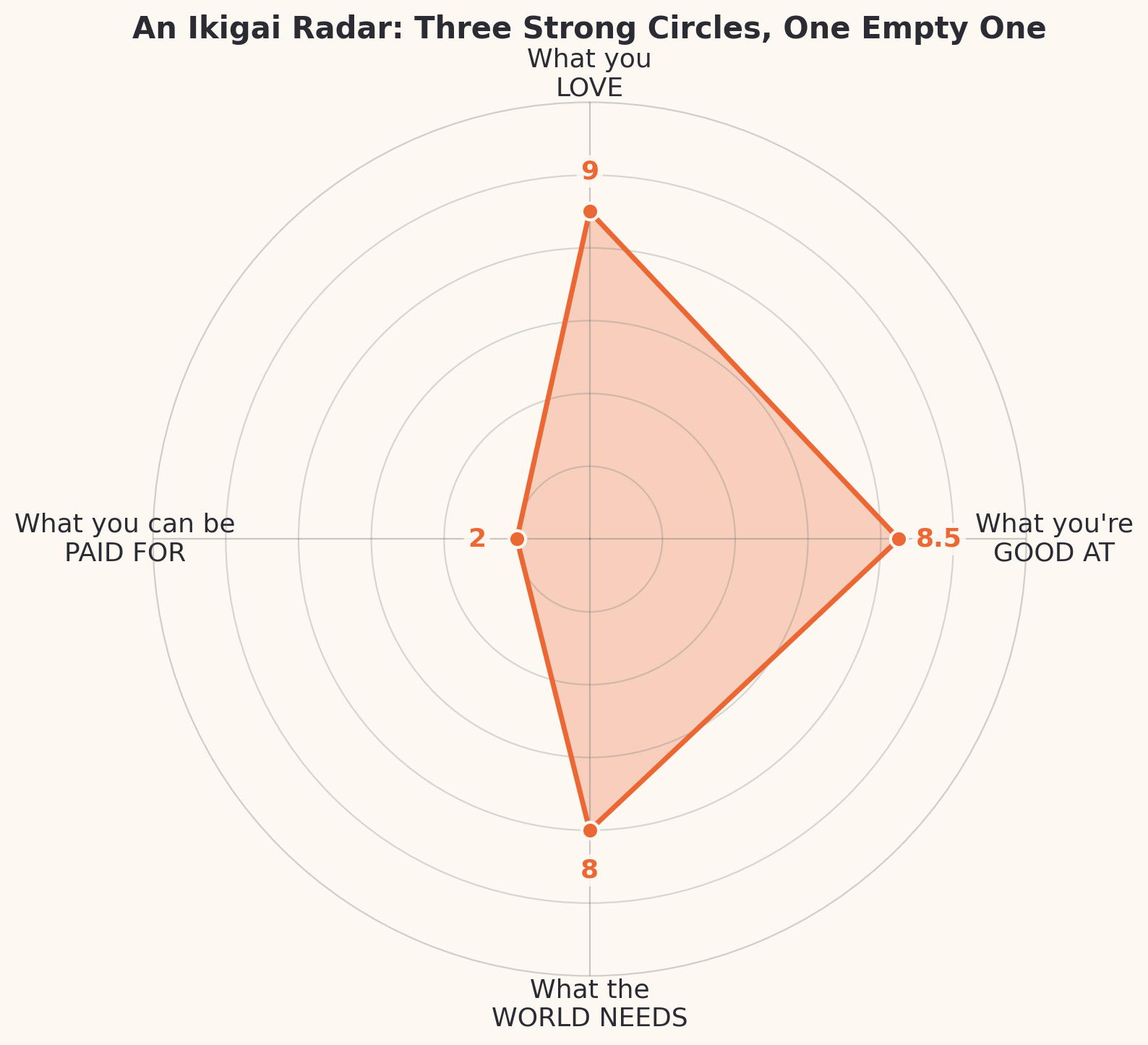
This is Kamiya’s tension between ikigai and livelihood playing out almost exactly as she described it six decades ago: the “why” is intact and strong, but the means of living hasn’t caught up to it yet. The fix isn’t to question the other three circles, or to conclude that software isn’t “really” her path — it’s to treat the fourth circle as a specific, solvable proof problem. In her book, that’s exactly the approach: casual work and a small, deployed portfolio project close the “paid for” gap without her having to compromise on love, skill, or need at all. An ikigai audit here doesn’t invent a new direction; it correctly diagnoses which one of four things is actually missing, so effort goes toward fixing that one thing instead of a generic, unfocused job search.
Denise: when AI removes the task but not the purpose
Denise is one of three central characters in Skillset Centre’s companion workbook, AI-Powered Jobsearch: The Savvy Guide for Mature-Age Jobseekers. She spent twenty-two years rising from sales associate to regional operations manager at a mid-size US retail chain, based in Dayton, Ohio. At fifty-seven, she’s six months into a job search after her employer consolidated its regional offices and automated most of the inventory management work that had defined her role for over a decade. She’s picking up shifts at a local hardware store to cover the gap, and hasn’t had a single callback from the roughly twenty management positions she’s applied for.
Denise’s situation is the sharpest illustration in this whole article of why AI raises the stakes for this kind of self-audit rather than lowering them. Her actual job title — built around running an inventory system — is precisely the part that got automated. If she job-searches by re-applying for “regional operations manager, inventory focus” roles, she’s competing for a shrinking category of work against the exact software that replaced her. But that’s not what her four circles actually show.
What she’s good at was never really the specific inventory platform; it was diagnosing why a system had broken and retraining a team around the fix under real time pressure. What the world still needs is exactly that judgment — arguably more of it, since more organisations now have AI-driven systems that need a human who can tell when the automation itself is wrong. What she loves is the problem-solving and the people-management, not the spreadsheet. And what she can be paid for shifts once the target changes: operations and process-improvement roles, safety and compliance oversight, or implementation roles helping other organisations adopt the very systems that displaced her — all of which value exactly the pattern she has, even though the specific tool on her old resume is now redundant.
This is job crafting (Wrzesniewski & Dutton, 2001) starting from an accurate diagnosis instead of a guess, and it’s a direct, concrete answer to the “why does this matter more once AI is involved” question raised above: the tasks that get automated and the purpose that made someone good at those tasks are not the same thing, and confusing them in a job search — as Denise nearly did — means competing with software for jobs that no longer need to exist, instead of competing with other humans for the judgment that still does.
Putting This to Work: A Five-Step Ikigai Job Search Audit
- Take the test properly, once, without second-guessing your answers. Skillset Centre’s free Ikigai Test takes under ten minutes and produces a radar chart across all four circles — a genuine first read, not a personality label. The example career fields it points you toward span trades, care work, creative and technical fields, and business and operations — including recent additions grounded in Jobs and Skills Australia’s emerging-occupations research, such as renewable energy technicians and cybersecurity analysts — rather than skewing toward office or IT-only suggestions.
- Identify your weakest circle honestly. Most people’s gap looks like Priya’s (a “paid for” gap caused by missing proof, not missing ability) or like Denise’s (a “paid for” gap caused by the target role itself having changed underneath them). Naming which one you have changes what you do next.
- Ask Kamiya’s original question, not just the diagram’s. Not just “what do I enjoy and what am I good at,” but “what is this work actually for, and who is it for” — the existential version tends to surface the enduring pattern (Denise’s system-diagnosis judgment) underneath the disposable task (Denise’s specific software).
- Job-craft before you reskill. Before assuming the answer is a brand-new qualification, check whether reframing your existing strength toward a slightly different target role closes the gap faster — exactly what Denise’s case shows.
- Translate the result into your resume and interview narrative. A candidate who can say precisely why a role fits — not just that they want it — interviews better, and a validated sense of purpose is genuinely protective for wellbeing through a search that drags on (Fido, Kotera, & Asano, 2019), which itself lowers the risk of forcing a bad-fit decision out of sheer fatigue.
If any of this feels like it’s happening at the wrong life stage or in the wrong country for your situation, it’s worth reading alongside two related pieces on this site: Career Change After 50: How to Beat Age Discrimination and Get Hired, and 10 Things Not to Do When Using AI to Write Your Resume. Skillset Centre’s Personal Values Quiz and Mindset Quiz are also built to answer two closely related questions the Ikigai Test doesn’t fully cover on its own — what you need from a role to feel aligned, and how resilient your current patterns actually are — and the three are designed to be used together rather than in isolation.
The Bottom Line
The four-circle version of ikigai that shows up on posters and quiz landing pages is a decade-old Western invention layered onto a much older Japanese psychiatric concept and a bestselling book about neither careers nor diagrams. That’s worth knowing plainly, rather than repeating the myth. But knowing the real lineage doesn’t debunk the tool — it’s exactly what makes it trustworthy: a genuinely validated psychological construct, linked in peer-reviewed research to real wellbeing outcomes, increasingly recommended by career-development researchers as a complement to established frameworks, and — as both Priya’s and Denise’s situations show — one of the clearer starting points for an ikigai job search once AI starts eating the task layer of a job. Ready to see your own four circles? Take the free Ikigai Test — it takes about ten minutes.
Sources & Further Reading
- Kamiya, M. (1966). Ikigai-ni-tsuite [On the Meaning of Life]. Misuzu Shobo.
- García, H., & Miralles, F. (2016). Ikigai: The Japanese Secret to a Long and Happy Life. Penguin Random House.
- Fido, D., Kotera, Y., & Asano, K. (2019). English Translation and Validation of the Ikigai-9 in a UK Sample. International Journal of Mental Health and Addiction. Springer.
- Jedvaj, K., & Skrbinjek, V. (2025). Ikigai as a Framework for Career Counselling and Study Choices: Conceptual and Practical Perspectives in the Slovenian Context. Societies, 15(9), 264. MDPI.
- Wrzesniewski, A., & Dutton, J. E. (2001). Crafting a Job: Revisioning Employees as Active Crafters of Their Work. Academy of Management Review, 26(2), 179–201.
- Deci, E. L., & Ryan, R. M. Self-Determination Theory. selfdeterminationtheory.org.
Ikigai is part of what keeps a job search sustainable — see the Secret Duck in our Six Ducks Job Search Framework.