Not sure where your own strengths sit yet? Take the Mindset Quiz or the Employability Quiz to see where you stand before lining up these six ducks.
The Framework, in Two Halves
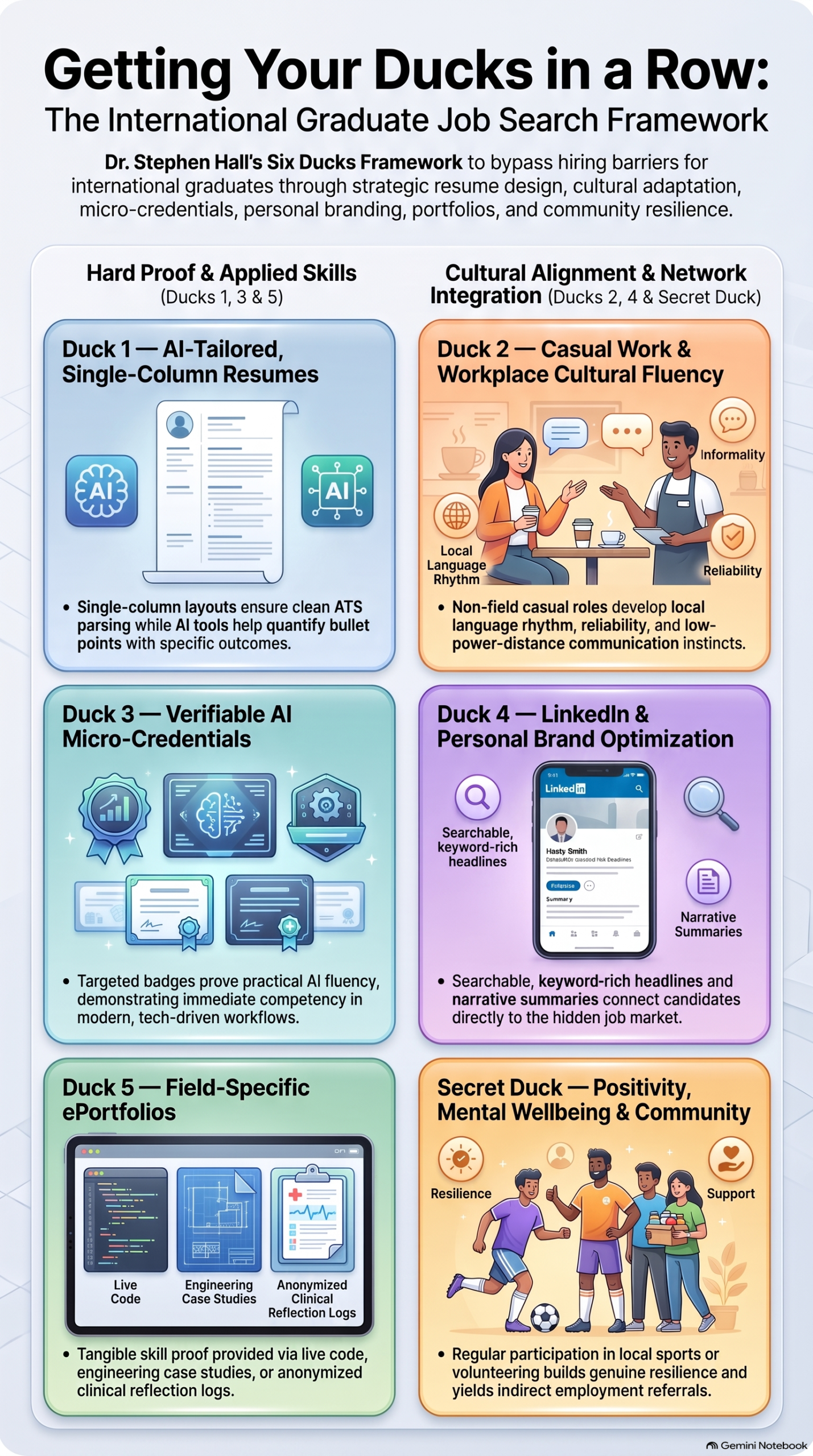
The six ducks split into two groups. Three are about hard proof and applied skills — the evidence a recruiter or an AI screening tool can actually verify. The other three are about cultural alignment and network integration — the human, relational side of getting hired that a resume alone can never carry. You need both. A brilliant resume with no cultural fluency stalls at the interview; a well-connected candidate with no verifiable proof stalls at the AI filter.Most applicant tracking systems still choke on multi-column layouts, tables, and graphics-heavy templates — your experience can be perfect and still never reach a human. A clean, single-column resume, tailored to each role’s actual keywords with AI as your editing assistant (not your ghostwriter), is the difference between landing in the “yes” pile and disappearing into the parsing errors.
A line on your resume claiming “AI-literate” is easy to write and easy to doubt. A verifiable micro-credential from a recognised provider — Google, Microsoft, Coursera and similar — is proof a recruiter can click through and confirm in seconds. See our free and paid AI courses for a fast way to start building this proof.
For many fields, a resume can only describe your work — an ePortfolio lets an employer actually see it. Case studies, writing samples, code repositories, design work or project outcomes, organised and easy to browse, turn “I can do this” into “here’s exactly how I’ve done it before.”
See a walkthrough of building one in our ePortfolio lesson.
Local casual or part-time work teaches things no course can: how meetings actually run, how feedback is really given, what “urgent” means in this workplace culture versus another. For international graduates especially, this lived experience becomes a quiet but powerful credential in itself.
See how your own instincts measure up — take the Work Culture Quiz.
▶ Watch Duck 2: Casual Work, Culture & Understanding Yourself (5:18)
Recruiters check LinkedIn before they check anything else you’ve sent them. A complete, keyword-aligned profile with a clear headline and real engagement in your field does two jobs at once: it gets you found in searches, and it backs up everything your resume claims.
Go deeper with our LinkedIn optimization lesson.
▶ Watch Duck 4: LinkedIn, Personal Brand & Networking (5:57)
This is the duck that holds the other five together. A job search is a marathon, not a sprint, and it’s genuinely harder when you’re navigating it far from home. Staying connected to community, protecting your wellbeing, and holding onto a realistic, positive outlook isn’t a “soft” extra — it’s what keeps you applying, learning and improving long enough for the other five ducks to pay off.
More on staying grounded through the search: Ikigai and Why It’s Important in AI Jobsearch.
▶ Watch the Secret Duck: Positivity, Mental Wellbeing & Community (5:19)
Want the Full Walkthrough?
This infographic is the summary. The full framework — case studies, step-by-step exercises, and ready-to-use AI prompts for each duck — is in our free book, AI-Powered Jobsearch: The Savvy Guide for International Students, and in our companion course, Creating Your Own AI Job Agent. If Duck 1 is where you’re stuck right now, start with 10 Things Not to Do When Using AI to Write Your Resume.Ready to line up your six ducks?
Get the Free Book