
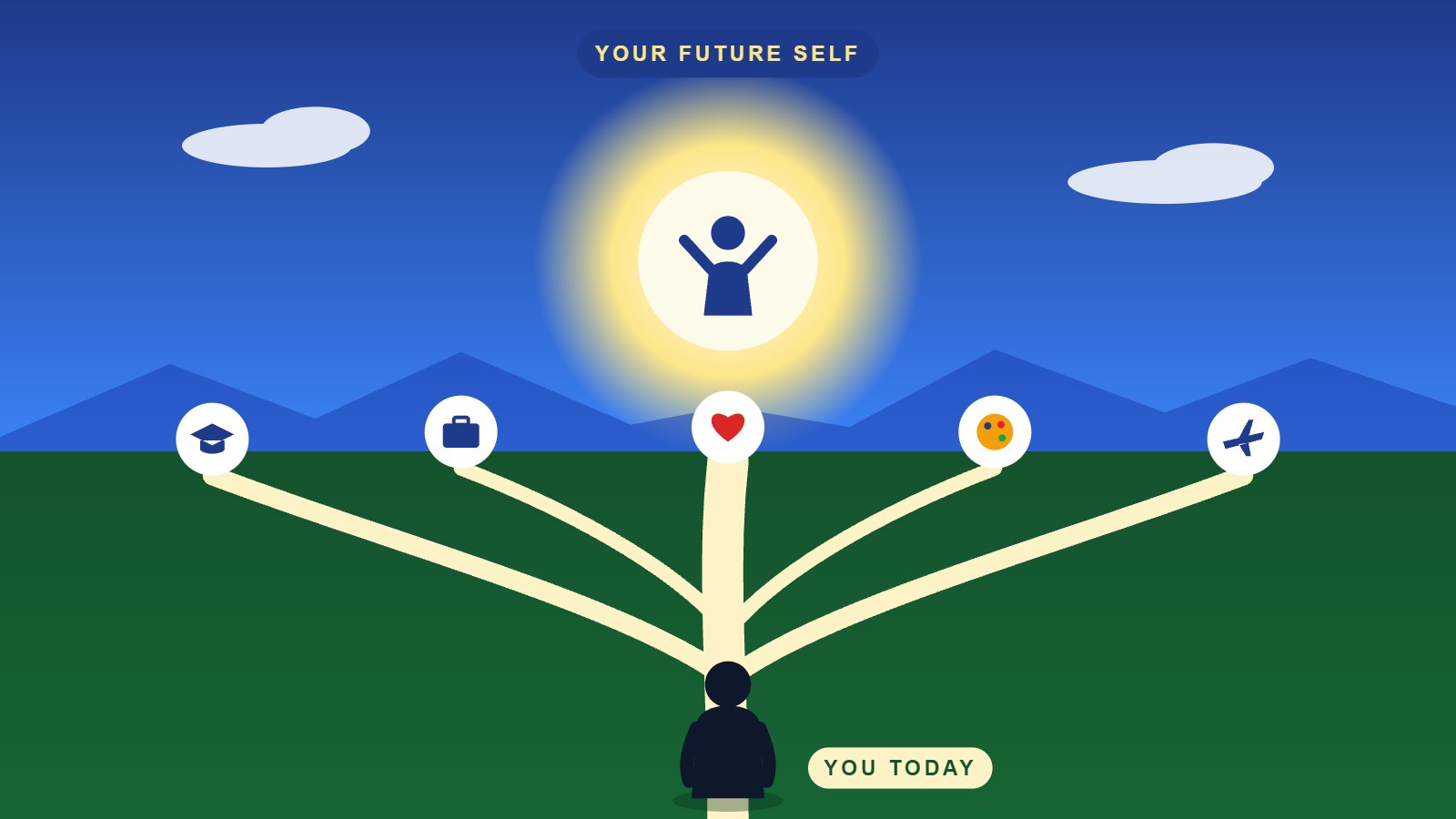
Why talk to your future self?
Your future self is the person you will be in three, five or ten years. Same name, same memories, but different skills, a different job and maybe a different life. Every choice you make today, from what to study to which job to take, is really a decision made on their behalf.
Here’s the catch: most of us treat that person like a stranger. In a Stanford brain-scanning study, thinking about yourself ten years from now looked more like thinking about someone else than thinking about yourself today. The people with the biggest gap were also the most likely to grab a smaller reward now instead of waiting for a bigger one later.
The good news is that the gap can be closed. In a follow-up study, people who saw a realistic aged image of themselves chose to put about twice as much money into long-term savings. When your future self feels real, you make better choices for them.
Newer research takes this further. In a 2024 MIT Media Lab study, young adults who had a short chat with an AI-generated version of their older self felt less anxious and more connected to who they would become.
Why it matters more now: AI is changing which tasks people do and which jobs exist. The plan you made at 18 may not fit the world you graduate into. Checking in with your future self helps you notice the drift early and change course while the change is still small.
Make a choice your future self will be proud of: Here’s a simple test before any big decision. Ask yourself, “Will the me of three years from now be proud I did this?” Your future self can’t thank you for staying comfortable. But they can be proud that you started the course, took the casual job that taught you something, or tried the path that scared you. Pride and regret both look back at today, so choosing for pride now is the best way to avoid regret later.
What it looks like in practice: “Talking to your future self” simply means picturing yourself a few years from now and asking three questions:
- What do I want to be doing, and who with?
- What choice today would my future self be proud of?
- What would I regret not trying?
The rest of this article shows how to turn those answers into a realistic plan.
The most useful career question in the age of AI isn’t “What job should I do?” It’s “Who do I want to be, and what mix of work gets me there?” Our free Ikigai Life Pathfinder helps you answer it. It combines what you love, how AI is changing your field and your real-life situation, then shows a realistic mix of paths you could follow.
It takes about ten minutes, needs no signup, and your answers never leave your browser.
TL;DR
- Talking to your future self works: people who feel connected to who they will be make better long-term choices, ones their future self can be proud of.
- AI is changing work fast: the World Economic Forum expects disruption equal to 22% of today’s jobs by 2030.
- Your future self is more likely to be a mix of work than a single job title.
- The Ikigai Life Pathfinder looks at three things: your Ikigai, how AI affects your work, and your life right now.
- You get a pathway mix across 13 paths, eight best-fit jobs chosen from more than 200 roles, practical next steps and a 30-day experiment.
- It’s a snapshot, so retake it every three months, or every month if you’ve been made redundant.
Work is changing faster than career advice
The World Economic Forum’s Future of Jobs Report 2025 expects 170 million new jobs and 92 million lost ones by 2030. That’s disruption equal to 22% of today’s jobs. It also expects around 40% of the skills people use at work to change in the same period.
AI is splitting work into two kinds. PwC’s 2026 Global AI Jobs Barometer found that jobs needing specific AI skills grew about eight times faster than the overall market, and those skills now carry an average wage premium of 62%. At the same time, PwC says AI is raising the value of human skills such as judgement, creativity and leadership.
So the picture isn’t simply “AI takes jobs”. It rewards people who know what they’re good at, choose work that AI lifts rather than replaces, and learn to direct the tools.
Why one job title is the wrong target
Most career quizzes hand you a list of job titles. That made sense when people stayed in one career for decades. It makes less sense now.
Many people already blend several kinds of work: a nurse who teaches first aid at weekends, an engineer who consults two days a week, a graduate who works part-time while retraining. Your future self is more likely to look like this than a single title. That’s why the Pathfinder gives you a pathway mix: your top three paths, with a percentage for each.
How the Ikigai Life Pathfinder works
The quiz has 40 short questions in three parts. Each part looks at your future from a different angle.
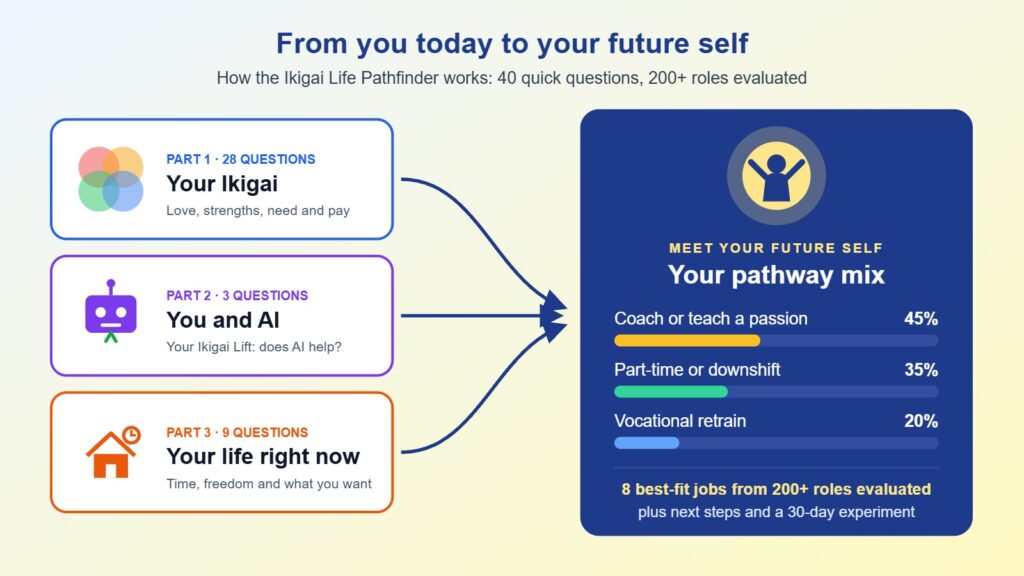
Part 1: Your Ikigai (28 questions)
Ikigai is a Japanese idea often described as your “reason for being”. It sits where four circles meet: what you love, what you’re good at, what the world needs and what you can be paid for. These are the same 28 statements as our popular Ikigai Test. They also reveal your top two interest areas, such as creative and analytical, or practical and people-focused.
Part 2: You and AI (3 questions)
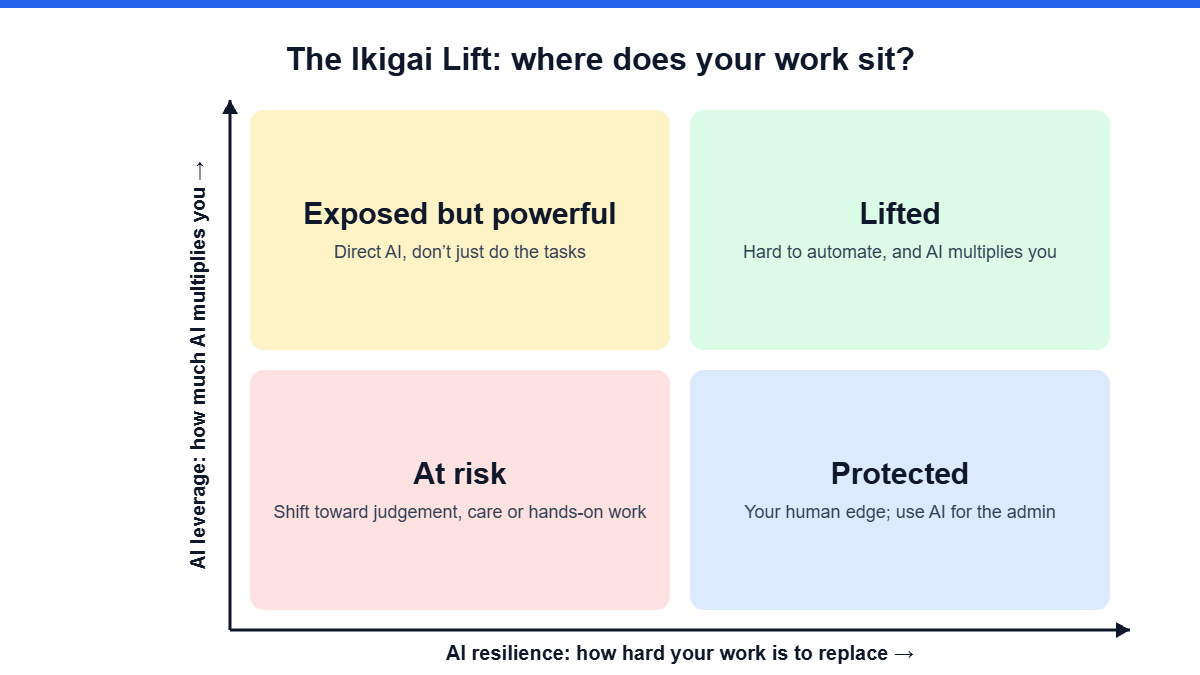
This part places your work on the Ikigai Lift, which uses two scores. AI resilience is how hard it is for AI to replace the core of your work; hands-on, people-facing and judgement-heavy work scores highest. AI leverage is how much AI can multiply what you do if you direct it well. The Lift comes from Dr Stephen Hall’s book Ikigai in the Age of AI, which builds on the classic four-circle Ikigai model.
Part 3: Your life right now (9 questions)
This is what most career tools leave out. A path only works if it fits your life. So the Pathfinder asks a few gentle questions: how much room you have to try something new, whether you would study, move or be your own boss, and whether you have a sport, hobby or skill you could teach. There are no questions about your income or savings in dollars.
Thirteen paths, not one
The Pathfinder scores you against 13 different ways of working:
- Stay and step up in your current organisation
- Vocational retraining, or going back to university
- Part-time or downshifting
- Casual work and contracting
- Portfolio and online work (two or three income streams)
- Self-employment or a franchise
- Coaching or teaching a passion, from rowing to music to coding
- Lifestyle or craft income
- Emigration
- Early or partial retirement
- Volunteering
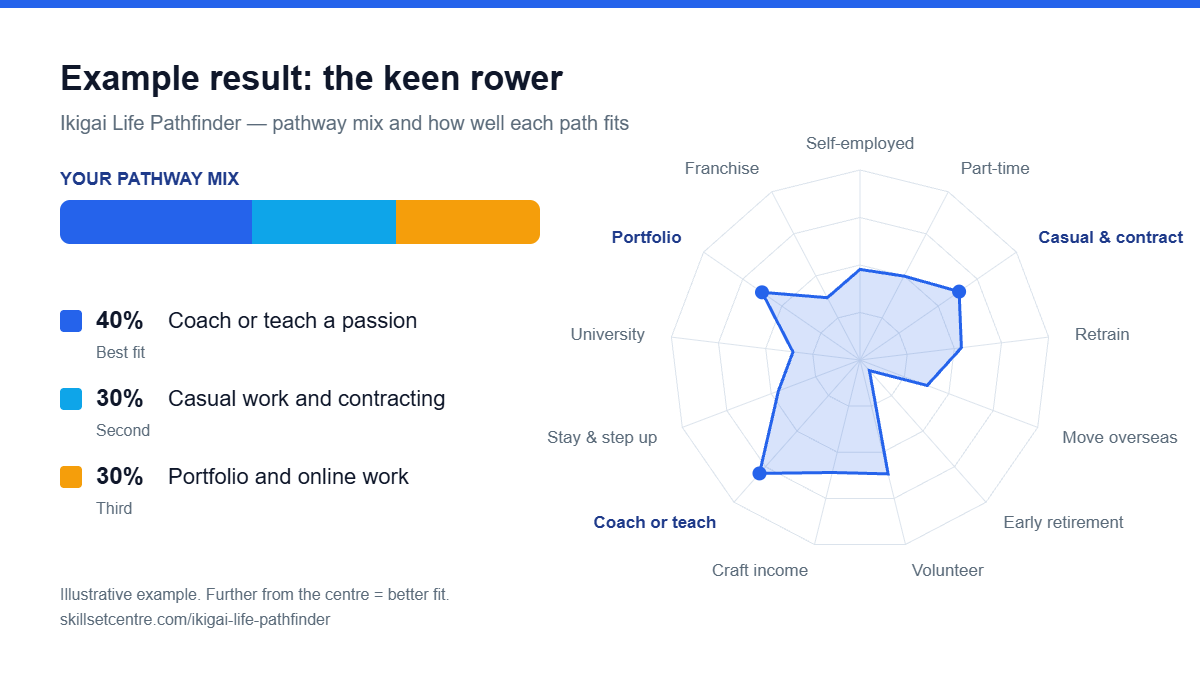
Your results show your top three as a mix, plus a spider chart of how well every path fits you. It’s often the second and third paths that surprise people most.
What your results include
The results are built to help you act, not just reflect. Depending on your answers, you’ll see:
- A 30-day experiment for each of your top paths: one small, low-risk test you can start this month.
- Eight jobs that match your top two interests, chosen from more than 200 roles we evaluated across 15 interest pairs and checked against O*NET, the US Department of Labor’s occupation database. Each shows the usual training route, from a short course to a degree plus further study.
- Start-soon jobs you could begin within weeks with a short certificate, if casual or part-time work is in your mix.
- How to get going: practical steps for your paths, from asking for a promotion to setting up a market stall or researching a move overseas.
- Your low-risk baseline: how to move your skills somewhere new without changing everything at once.
Three examples of a future self
These are illustrative examples, not real people, but they show how different the results can be.
The keen rower. An office worker who loves rowing, has competed and wants out of their current job. Their mix: coaching (40%), casual work and contracting (30%) and portfolio work (30%). Their 30-day experiment is to complete an entry-level coaching course and run three paid sessions with a local club.
The happy employee who wants more. Someone who likes their organisation but feels stuck gets “Stay and step up” as their main path (55%). Their first step is a six-month goal agreed with their manager, plus one AI tool that handles part of their job.
The graduate ready to study. A recent graduate who would study full-time sees “Go back to university” at the top, with vocational retraining close behind. Their job list shows the training route for each option, so a five-year path is clear from the start.
Your future self keeps changing: retake it every three months
Your result is a snapshot of today. Your skills, your situation and the world of work all keep moving, and AI is changing jobs quickly. A mix that fits you now may look different by next season.
So retake the Pathfinder every three months, and sooner if something big changes, such as a move, finishing study or a new caring role. If you’ve been made redundant, or your job is under threat, retake it every month while you look for your next step. Things can shift fast, and new paths often open once the first shock passes.
The Pathfinder remembers your last result on your own device and shows how your mix has changed. You can also add a reminder to your calendar straight from your results.
How to get the most from it
- Answer for now, not for the ideal you. The results are only as honest as your answers.
- Run one 30-day experiment. Small tests beat big plans. You learn more from one paid lesson or one honest conversation than from a month of research.
- Turn it into a plan. Our free Plan Builder turns your experiment into a week-by-week plan.
- Come back every three months and compare your mix with last time.
What the Pathfinder is not
It’s a tool for self-reflection, not a verdict and not professional career, financial or migration advice. It can’t measure your ability, and it doesn’t know the rules where you live. Use it to start better conversations with yourself, your family and the people already doing the work you’re curious about.
Frequently asked questions
Is the Ikigai Life Pathfinder free?
Yes. It’s free, there’s no signup, and it takes about ten minutes to complete all 40 questions.
Is my information saved anywhere?
Your answers and results stay in your own browser. Skillset Centre doesn’t see them. If you retake the quiz on the same device, your browser remembers your last mix so you can compare.
How is it different from the Ikigai Test?
The Ikigai Test shows what fits you. The Pathfinder adds how AI affects your work and nine questions about your life right now, then shows how you could get there across 13 different paths, with practical next steps.
How often should I retake it?
Every three months, or sooner after a big change. If you’ve been made redundant or your job is under threat, retake it every month while you look for your next step.
Find your future self today
AI will change most jobs. But it also opens more ways to build a working life that fits who you are. The Ikigai Life Pathfinder is free, needs no signup and takes about ten minutes.
Take the Ikigai Life Pathfinder →
Sources & Further Reading
- Hall, S. (2026). Ikigai in the Age of AI: NEET No More — Find Where You Fit Before a Machine Does It for You. Skillset Centre. ISBN 978-0645738988.
- Hall, S. (2026). AI-Powered Jobsearch: Getting Your Ducks in a Row (International Students and Mature-Age editions). Skillset Centre.
- Kamiya, M. (1966). Ikigai-ni-tsuite [On the Meaning of Life]. Misuzu Shobo.
- García, H., & Miralles, F. (2016). Ikigai: The Japanese Secret to a Long and Happy Life. Penguin Random House.
- Ersner-Hershfield, H., Wimmer, G. E., & Knutson, B. (2009). Saving for the future self: Neural measures of future self-continuity predict temporal discounting. Social Cognitive and Affective Neuroscience, 4(1), 85–92.
- Hershfield, H. E., Goldstein, D. G., Sharpe, W. F., Fox, J., Yeykelis, L., Carstensen, L. L., & Bailenson, J. N. (2011). Increasing saving behavior through age-progressed renderings of the future self. Journal of Marketing Research, 48(SPL), S23–S37.
- Hershfield, H. (2023). Your Future Self: How to Make Tomorrow Better Today. Little, Brown Spark.
- Pataranutaporn, P., Lapapirojn, A., Winson, K., Ouppaphan, P., Yin, P., Lertsutthiwong, M., Maes, P., & Hershfield, H. (2024). Future You: A conversation with an AI-generated future self reduces anxiety, negative emotions, and increases future self-continuity. 2024 IEEE Frontiers in Education Conference (FIE). MIT Media Lab.
- Fido, D., Kotera, Y., & Asano, K. (2020). English translation and validation of the Ikigai-9 in a UK sample. International Journal of Mental Health and Addiction, 18, 1352–1359.
- Jedvaj, K., & Skrbinjek, V. (2025). Ikigai as a framework for career counselling and study choices: Conceptual and practical perspectives in the Slovenian context. Societies, 15(9), 264.
- Holland, J. L. (1997). Making Vocational Choices: A Theory of Vocational Personalities and Work Environments (3rd ed.). Psychological Assessment Resources. (The RIASEC interest model used to match jobs.)
- O*NET OnLine. Occupation interest codes and Job Zones. US Department of Labor.
- World Economic Forum (2025). Future of Jobs Report 2025.
- PwC (2026). 2026 Global AI Jobs Barometer.