
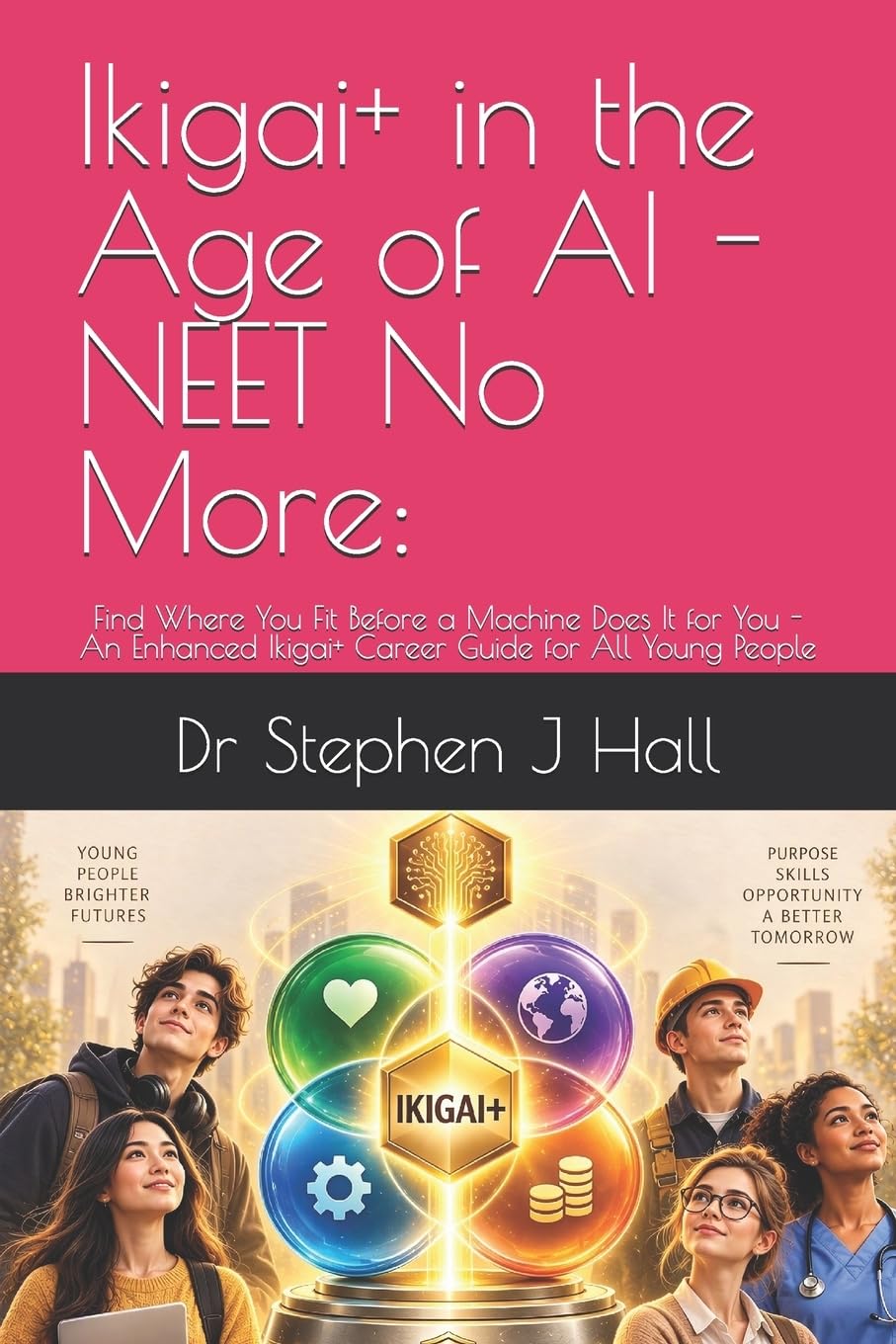
The Ikigai Lift
Find where you fit — before a machine does it for you.
Published as Ikigai+ in the Age of AI on Amazon & Kindle
- The Ikigai Lift: a 14-day reset, not vague advice
- Real case studies: Dan, Jordan, Chelsea
- All four ikigai circles reframed for the AI era
- Every prompt and template included
Kindle: AUD 7.29 · USD 4.99 · GBP ~3.74 — less than a coffee, a glass of wine, or a pint.
If you’re the one reading this
This book talks to you, not about you. It’s built around three real young people — Dan, Jordan, and Chelsea — not theory, and it’s written to be an easy read: short chapters, plain language, no jargon you have to decode. Easy to read doesn’t mean light on substance — the Ikigai Lift itself is drawn from real 2026 labour-market data, so what you get at the end is a genuine answer, not a feel-good exercise.
If you’re a parent, buying it for your child
If you’re worried about a son, daughter, or young person who feels stuck, this is something you can hand over without it feeling like more advice from someone who doesn’t get it. It’s rigorous — built on real labour-market data and written by someone who was in their shoes — but it never talks down to them. The 14-day structure gives them a concrete next step, not just more things to think about.
About the book
If you’re a young person who feels lost and left behind — watching the world change around you faster than anyone seems willing to explain, and wondering what all of it actually means for how your own life is going to unfold — this book was written for you, not around you. Its first promise is one most career advice never makes: if the usual advice hasn’t worked for you, that’s not a personal failing. The advice itself has been broken, not you. You don’t need a CV, a degree, or a finished answer to any question about yourself to open this book and take a real first step.
The Ikigai Lift takes the Japanese concept of ikigai — the intersection of what you love, what you’re good at, what the world needs, and what you can be paid for — and does something no ikigai book has done before: it challenges the idea that finding your sweet spot is the end of the story.
The classic ikigai diagram is flat — four overlapping circles, and wherever they meet is supposed to be your answer. This book adds a dimension that diagram was never built to show. Call it the Ikigai Lift: a third axis rising straight up from that same sweet spot, split into two honest readings — AI Resilience (how exposed that spot actually is to automation, drawn from real 2026 labour-market data) and AI Leverage (how far AI can amplify the pay and opportunity sitting at that exact spot). Two people can land on the identical sweet spot and get completely different readings on both — which is the point: your ikigai was never built to tell you whether AI is quietly hollowing out the ground underneath it, or lifting it. This book measures that, instead of guessing at it.
Through the real-world-grounded stories of Dan, Jordan, and Chelsea — three young people standing in for the millions who, like them, “genuinely wouldn’t know where to start” — the book walks through each part of the ikigai framework with AI squarely in view, then runs each of their sweet spots through the Ikigai Lift itself. Dan, a mechanical engineering graduate, discovers his technical skills sit in the most AI-exposed category measured — and the highest-paying once he stops executing and starts directing. Jordan, an apprentice electrician, finds out his trade is one of the most AI-resistant paths in the data. Chelsea, who left school with no qualifications and no plan, shows that the book’s starting point doesn’t require a CV — or even a track — to begin.
From there, a practical 14-Day Ikigai Reset turns reflection into action — a day-by-day plan to move from stuck to moving, closing with the reader plotting their own Ikigai Lift reading rather than someone else’s.
This isn’t a book about fearing AI or pretending it isn’t happening. It’s about taking the bigger-picture view: understanding how the ground is shifting, then deliberately choosing where to stand. Written for young people who are NEET, nearly NEET, or just quietly frustrated that nothing out there seems to fit — and for anyone who wants an honest, practical answer to “what do I actually do now?”
Includes worked examples, a glossary of AI-era job-search terms, a toolkit for working the hidden job market, and an edition-specific opening chapter addressing the UK youth employment landscape.
About the author
With many years of teaching experience across both Higher Education and the VET sector, he helps learners navigate technology, digital transformation, and the future of work. His PhD explored how people learn in virtual reality environments, and his research continues to be presented at national and international conferences. Supported by four university degrees — including two master’s — he brings a practical, evidence-based perspective to emerging technology. Before moving fully into education and research, he owned and operated a recruitment company, gaining firsthand insight into how people build careers, adapt to change, and succeed in fast-moving industries.
Explore more from Skillset Centre
The Ikigai Lift builds on tools and resources you can try for free right now. If you want to go further than the book, start with the Ikigai Test to see your own four circles mapped out, or the Six Ducks framework for a practical, step-by-step job-search plan. There’s also a free guide for parents navigating a child who’s NEET or nearly NEET, and two further books in the AI-Powered Jobsearch series — one for international students, one for mature-age jobseekers — built on the same evidence-based approach.
From the Insights blog:
Get your copy today
For yourself, or for a young person who needs it.
| Edition | Australia | UK | US |
|---|---|---|---|
| Kindle | AUD 7.29 | ~£3.74 | US$4.99 |
| Paperback | AUD 14.49 | see Amazon | from US$9.99 |
UK Kindle price is an approximate conversion shown at checkout; UK paperback pricing is set by Amazon at purchase.